MANUFACTURING SERVICES
Architectural Product Manufacturing: GFRC, GFRP, Metal and Stone
Mould making, casting, fabrication and finishing for facade and interior products, produced to approved shop drawings in Faisalabad and delivered across Pakistan.
Manufacturing at a glance
- Mould making from approved drawings
- GFRC and GFRP casting
- Cast marble, cast polymer and stone
- Architectural metal fabrication
- Checked against shop drawings before delivery
WHAT WE MANUFACTURE
Custom Architectural Product Manufacturing
Architectural manufacturing is different from mass production. Each project has its own profiles, sizes, colours and fixing details, so production is built around approved drawings and samples rather than a fixed catalogue.
HB Design Driven manufactures facade cladding, cornices, column covers, screens, railings, vanity tops, shower walls, countertops and cast stone details in six material systems. Work typically moves from pattern and mould preparation, through casting or fabrication, to finishing, inspection, packing and delivery, with each piece checked against the project’s shop drawings.
Because one team handles design support, manufacturing and installation, production knowledge feeds back into the design. Panel sizes, joints and fixings are chosen so they can be made accurately, moved safely and installed efficiently.
Manufacturing capabilities
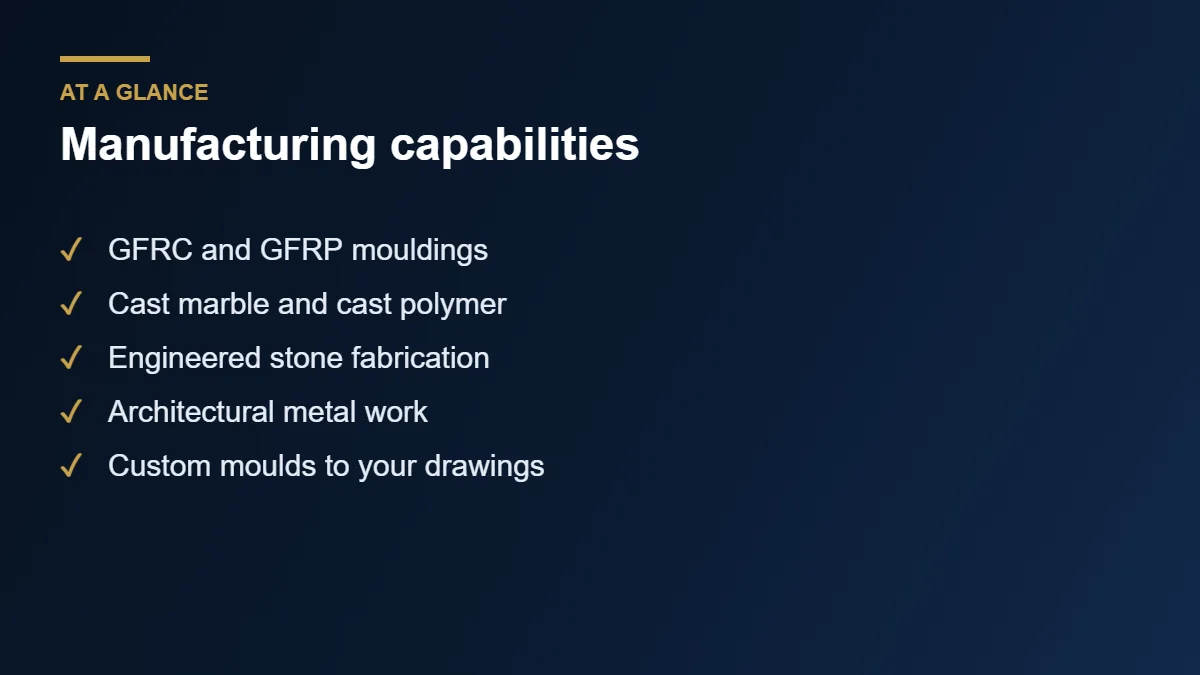
- Mould and pattern making
- GFRC spray-up and premix casting
- GFRP lamination and finishing
- Cast marble and cast polymer production
- Engineered stone and cast stone
- Architectural metal cutting, forming and finishing
BY MATERIAL
How We Manufacture Each Material
Each system has its own production route, tooling and quality checks.
GFRC
GFRC casting
Spray-up or premix casting into moulds, followed by controlled curing and finishing of panels, cornices and column covers.
GFRP / GRP
GFRP lamination
Gelcoat and layers of glass fibre and resin built up in moulds to form light, durable shells.
METAL
Metal fabrication
Cutting, perforating, folding, welding and finishing of aluminium and steel panels, screens and railings.
CAST MARBLE
Cast marble production
Gelcoated moulds, cast resin and filler mixes, then trimming and polishing of vanity tops, walls and sills.
CAST POLYMER
Cast polymer and solid surface
Cultured surfaces cast in moulds and solid surface fabricated and jointed from sheet.
STONE
Engineered and cast stone
Slab cutting and shaping for quartz and sintered stone, and mould casting for architectural cast stone.
THE WORKFLOW
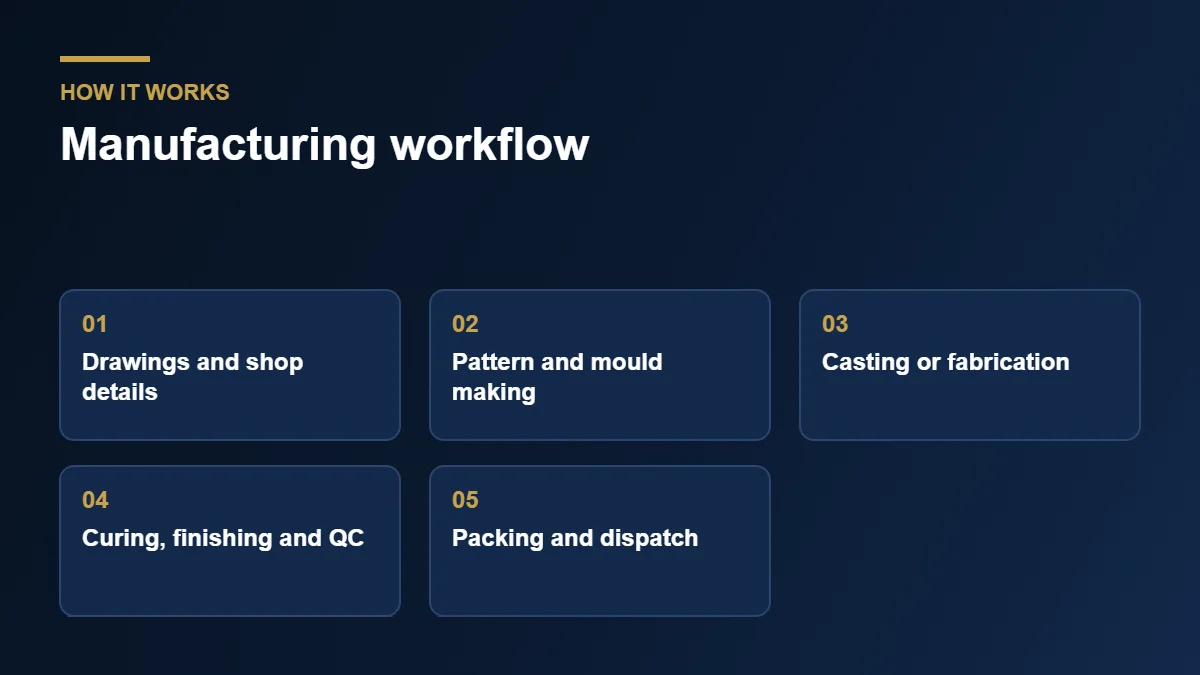
From Approved Drawing to Finished Product
A repeatable workflow keeps quality consistent across hundreds of pieces.
01
Shop drawings and approval
Panel sizes, joints, fixings and finishes are agreed on drawings and samples before production starts.
02
Pattern and mould making
Patterns and moulds reproduce the approved profile and surface, so repeated pieces match.
03
Casting or fabrication
Material is cast, laminated, cut or formed to the required thickness and shape under controlled conditions.
04
Curing and finishing
Cast pieces cure, then edges, surfaces and colours are finished, coated or polished as specified.
05
Quality inspection
Each piece is checked for dimensions, flatness, surface quality and colour against the drawings and samples.
06
Packing, labelling and delivery
Edges and faces are protected, pieces are labelled to the drawing set and delivered in an agreed window.
QUALITY CONTROL
Quality Checks Built Into Production
Quality is easier to build in than to inspect in. Production is organised around approved shop drawings and samples, with checks at key points: mould accuracy, material mix and thickness, curing, finishing and final dimensions.
Each finished piece is labelled to match the installation drawings so it can be placed in sequence on site. If your specification requires specific test reports or standards compliance, tell us at the start so we can confirm what is available and plan any sampling or testing.
Typical checks
- Mould and pattern accuracy
- Material mix and thickness
- Curing and strength gain
- Dimensions, flatness and squareness
- Surface finish and colour
- Labelling and packing

LEAD TIME
What Affects Manufacturing Lead Time
Lead time is mostly decided before the factory starts.
Shop drawing approval
The time taken to review and approve drawings and samples is usually the biggest driver of the schedule.
Mould complexity and repetition
Complex profiles take longer to tool, but repeated panels from one mould are fast to produce.
Quantity and size
Larger volumes and oversized pieces need more production and curing capacity and careful handling.
Finish and testing requirements
Special finishes, colour matching and test samples add steps that are best planned early.
Capability
Manufacturing Capabilities Across Materials
Our manufacturing capability covers the materials that architects specify most often for facades, interiors and landscape features. Glass fibre reinforced concrete and polymer suit thin, lightweight cladding and ornament, cast marble and cast polymer deliver classical detail, engineered stone provides durable surfaces, and fabricated metal supplies screens, fins and canopies. Offering several materials under one roof simplifies coordination and keeps appearance consistent across a building.
Every manufacturing project starts with the pattern. A master shape is carved, machined or 3D printed from the drawings, refined until the profile is exact, and then used to create a production mould. Mould quality governs surface finish, so we invest time in preparation, release treatment and repair. A well-built mould can produce many identical pieces, which is what makes repeat elements economical.
Mixing and casting follow documented recipes. Cement, sand, fibre, resin, filler and pigment are measured by weight, mixed to a controlled consistency and placed into the mould using spray, pour or compaction methods suited to the product. Operators record batch details so that every unit can be traced back to its materials and date of production, which supports quality audits.
Curing is a stage that cannot be rushed. Concrete products need moisture and temperature control to develop strength, while resin products require time to polymerise fully. Rushing this step risks cracks, distortion and weak surfaces. Our manufacturing programme builds curing time into every schedule so that units are strong, stable and ready for transport.
Finishing brings the design to life. Surfaces are demoulded, trimmed, ground, polished, etched, painted or sealed according to the approved sample. Colour is matched under controlled lighting, and any repairs are blended invisibly. The result is a set of components that look consistent from one end of the elevation to the other, which is the true measure of good manufacturing.
Quality Control
Inspection, Testing and Documentation
Quality control is built into each stage, not added at the end. Incoming materials are checked, moulds are inspected before use, and finished pieces are measured against the drawing. Tolerances are agreed in advance, so a unit that is a few millimetres out of line is caught before it reaches site, where correction would be slow and costly.
Strength and durability are verified using sample coupons, test cubes or trial panels, depending on the material. Results are recorded and made available to the consultant on request. For critical elements, we welcome witness testing and workshop visits, because open inspection builds trust and helps the design team approve work quickly.
Visual inspection is just as important. Trained staff examine every face under strong light, looking for voids, cracks, colour variation, tool marks and edge damage. Approved reference samples are kept in the workshop so inspectors can compare production units against the agreed standard, which keeps judgement consistent across shifts and batches.
Documentation supports the physical work. Each order has a production file containing drawings, batch records, inspection sheets, photographs and delivery notes. If a question arises years later, the file explains what was made, when and from what. This level of record keeping is especially valuable for large projects and public buildings.
Continuous improvement completes the loop. Defects and site comments are reviewed, root causes are identified and moulds, mixes or procedures are adjusted. Over time, this discipline raises accuracy and reduces waste, which benefits clients through lower cost and better quality in every new manufacturing batch.
Planning
Lead Times, Logistics and Coordination
Lead time depends on the number of moulds, the size of the order, the complexity of the finish and the curing method. Simple repeat profiles can move quickly, while bespoke sculpted elements need more time for pattern making and approval. We give a realistic programme at quotation stage and update it whenever the design changes.
Early decisions speed up manufacturing. Freeze the profile, confirm quantities, approve the finish sample and release the drawings as soon as possible. Late changes may require new moulds or rework, so it helps to keep the design team and the factory in regular contact. Weekly progress calls are enough to keep most projects on track.
Packing and transport protect the investment. Units are wrapped, padded and strapped on frames or crates, labelled with a location code and loaded in installation order. Long or fragile pieces travel with extra support, and delivery vehicles are chosen to suit access conditions at the site. Our full service range explains how packing links to installation.
Coordination with site teams prevents delays. Storage areas, lifting equipment and access times are agreed before delivery, and the installer receives a sequence plan showing which units are needed first. Our installation team can visit the workshop to inspect units before they ship.
For a broader introduction to the process, the precast concrete overview on Wikipedia describes how factory-made elements are produced and erected. To learn about specific materials, visit GFRC, GFRP or cast marble, and contact us to start your project.
Responsible Production
Efficiency, Safety and Environmental Care
Efficient production reduces waste. Mould reuse, accurate batching and offcut recycling lower material loss, and careful nesting of metal parts maximises sheet utilisation. Water used for cleaning and curing is managed carefully, and packaging is designed to be reused or recycled wherever possible. These practices cut cost and environmental impact at the same time.
Worker safety is a priority. Operators wear protective equipment, workshops are ventilated, resins and chemicals are stored correctly and lifting equipment is inspected regularly. A safe, well-organised shop is also a productive one, because skilled people can concentrate on quality instead of firefighting preventable problems.
Skilled craftsmanship remains essential. Machines help with accuracy and speed, but pattern makers, finishers and painters bring judgement that technology cannot replace. We train staff continuously and encourage them to raise concerns early, which is why many of our best improvements start on the workshop floor rather than in the office.
Material Notes
Manufacturing Notes for Each Material
Glass fibre reinforced concrete is usually sprayed or premixed into steel or rubber moulds, producing shells that are thin yet strong. Manufacturing of these panels depends on correct fibre content, careful compaction and controlled curing. Steel stud frames are bonded to the back to carry the load to the building structure. Large panels are lifted with dedicated points cast into the frame.
Glass fibre reinforced polymer is laid up in open moulds. A gelcoat is applied first to form the visible surface, then layers of glass fibre and resin are added and rolled to remove air. Manufacturing quality depends on consistent resin ratios, a clean shop and enough cure time before demoulding. Ribs and returns are added to stiffen larger parts.
Cast marble and cast polymer are poured or pressed into silicone, polyurethane or fibreglass moulds. Fine detail is captured easily, so mould preparation and release treatment are critical. After casting, pieces are trimmed, filled, sanded and finished. Manufacturing of these decorative products rewards patience, because a rushed demould can mark the surface.
Engineered stone slabs are compacted under vibration and vacuum, cured and then calibrated to a precise thickness. They are cut and edged by CNC equipment using templates from site measurements. Metal fabrication follows a different path: cutting, folding, welding, coating and assembly. Each method needs its own quality plan, which our manufacturing team maintains and updates.
Combining materials in one package helps clients. Colour and texture can be matched across product families, joints can be coordinated, and a single delivery schedule can cover everything needed for an elevation. Review our product categories to see how different materials work together.
Choosing a Partner
How to Choose a Manufacturing Partner
Selecting a manufacturing partner is about more than price. Ask to see completed work, visit the factory, review quality records and speak to previous clients. A transparent partner will welcome these questions and answer them clearly, because open inspection is the best evidence of confidence in the work.
Check capacity and communication. Can the factory handle your volume within your timeline? Who will answer questions and supply progress updates? Does the team understand drawings and propose improvements? Reliable manufacturing partners react quickly, document decisions and flag risks early instead of hiding them until delivery day.
Compare quotations carefully. Make sure each bid covers the same scope, including moulds, finishes, packing, transport and installation support. A very low price may exclude important items or signal compromises in materials and process. Itemised proposals make comparison easier and prevent surprises after the contract is signed.
Finally, consider the relationship. Large buildings require months of cooperation, so choose a team that listens, adapts and keeps its promises. If you would like to discuss your project, contact HB Design Driven and we will review your drawings and suggest the most practical manufacturing route.
FAQ
Manufacturing: Frequently Asked Questions
GET STARTED
Request a Manufacturing Quote
Send your drawings, quantities and finish preferences and we will come back with a schedule and price. Call +92 300 6685798 or email hbdesigndriven@gmail.com.