ENGINEERED AND ARTIFICIAL STONE
Engineered and Artificial Stone: Countertops, Panels and Cast Stone
Engineered quartz, sintered stone and cast stone made to your drawings: consistent, hard-wearing surfaces and architectural details for interiors and exteriors.
Engineered stone at a glance
- Three families: engineered quartz, sintered stone, cast stone
- Consistent colour and pattern across slabs
- Countertops, wall panels, copings, sills and details
- Fabrication needs dust-control discipline
- Made to your dimensions
WHAT IS ENGINEERED STONE?
What Is Engineered and Artificial Stone?
Engineered and artificial stone is a group of manufactured materials designed to look and perform like natural stone while offering more consistent colour, pattern and properties. In architecture it usually means three families: engineered quartz, sintered stone and cast stone.
Engineered quartz blends crushed quartz with resin and pigment into slabs for countertops, vanity tops and wall panels, with a very uniform appearance and low maintenance. Sintered stone is formed from mineral powders compacted and fired at high temperature, giving large, hard-wearing, heat and UV-resistant slabs suited to worktops, cladding and floors. Cast stone, also called reconstituted or architectural cast stone, is a cement-based material cast in moulds to replicate natural stone in copings, sills, quoins, balustrades and mouldings.
Each family has its own strengths. Quartz is a favourite for kitchen counters, sintered stone for large panels and exposed surfaces, and cast stone for traditional stone detailing on buildings. A good specification starts with where the surface will be used and what it must withstand.
HB Design Driven fabricates and casts these products to approved drawings, and can advise on which family suits your brief. See also GFRC for lightweight facade elements and cast polymer for seamless wet-area surfaces.
Key facts
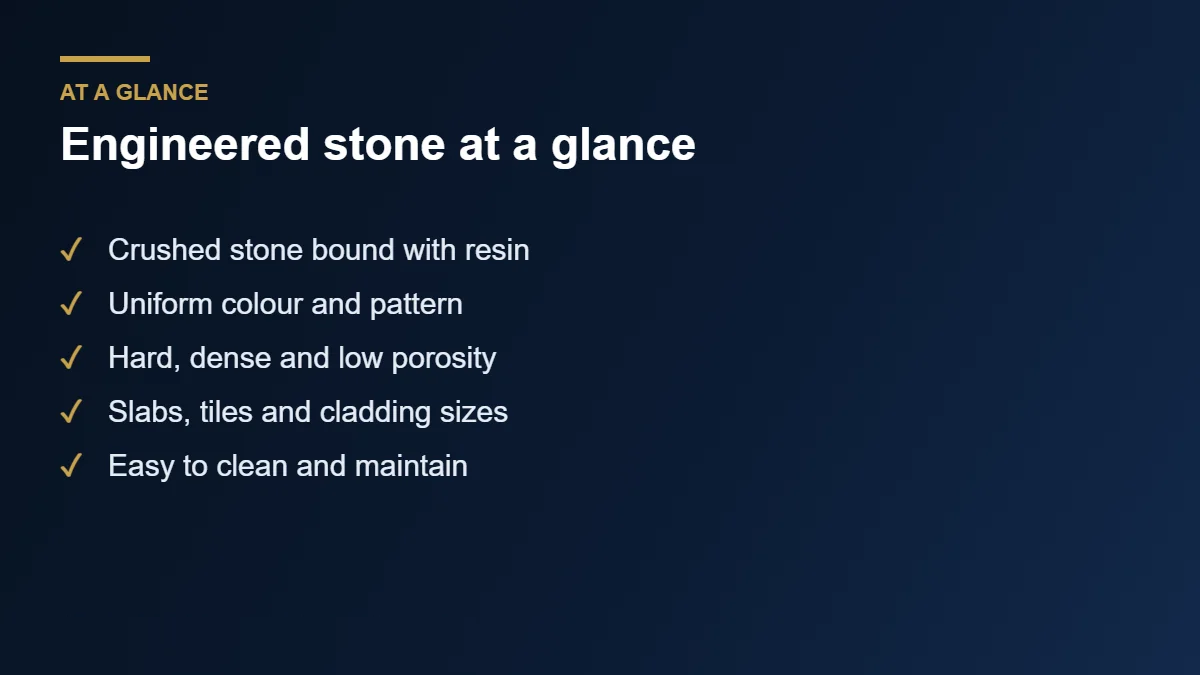
- Engineered quartz: crushed quartz bound with resin
- Sintered stone: compacted and fired mineral slabs
- Cast stone: cement-based, cast in moulds
- Consistent colour and pattern
- Low-maintenance surfaces
- Cast stone suits exterior detailing
APPLICATIONS
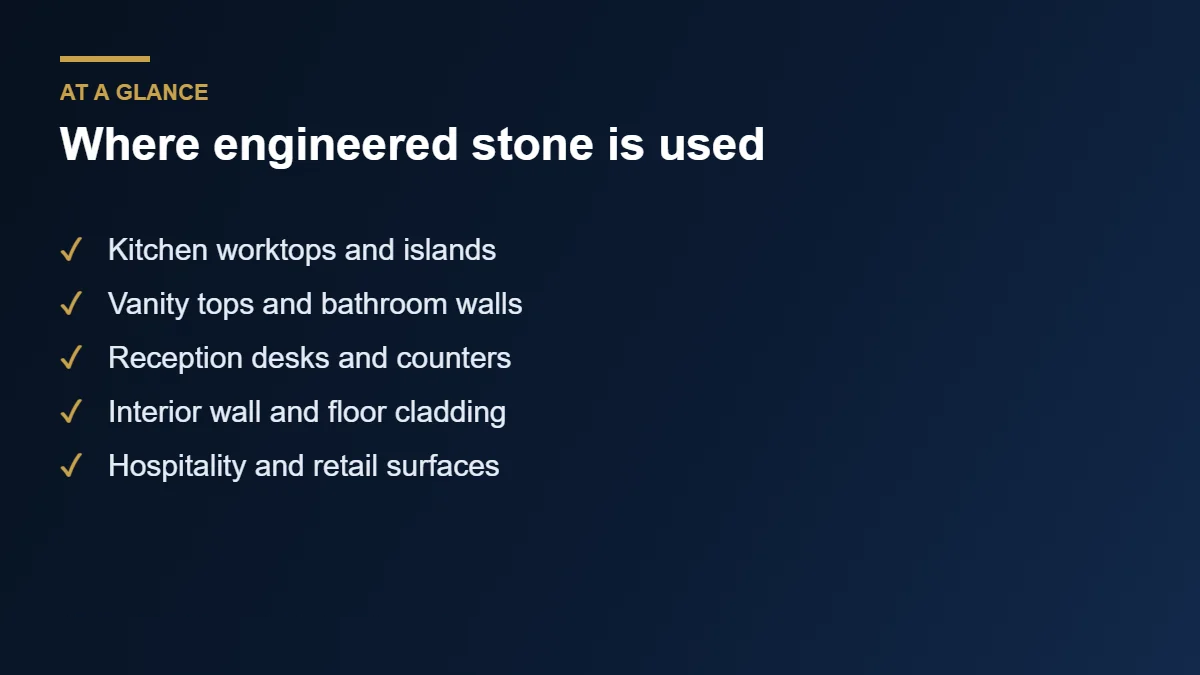
Where Engineered Stone Is Used
Different families suit different jobs, indoors and out.
COUNTERTOPS
Kitchen and bathroom countertops
Hard-wearing, low-maintenance work surfaces and vanity tops in consistent colours.
PANELS
Wall panels and feature walls
Large-format slabs for lobbies, bathrooms and feature areas.
COPINGS
Copings, sills and parapets
Cast stone caps and sills that finish walls and shed water.
DETAILS
Quoins, mouldings and balustrades
Traditional architectural details cast to repeat across a building.
SURFACES
Reception desks and bars
Durable surfaces for commercial counters and hospitality.
EXTERIORS
Cladding and paving
Sintered stone and cast stone options for exposed applications, subject to the product.
BENEFITS AND TRADE-OFFS
Benefits and Trade-Offs of Engineered Stone
Engineered stone is attractive and consistent. Safe fabrication is the key condition.
Advantages
- Uniform colour and pattern across slabs
- Hard-wearing and low-maintenance surfaces
- Large-format options with sintered stone
- Cast stone replicates natural stone details at repeatable cost
- Wide range of colours and finishes
- Suits both interiors and, with the right product, exteriors
Points to consider
- Quartz products contain a high share of crystalline silica, so cutting needs wet methods, extraction and respiratory protection
- Heavier than GFRC and GFRP
- Resin-based quartz can be affected by high heat and prolonged UV
- Seams and edges need skilled fabrication
- Sintered slabs need careful handling because of size and weight
- Colours and patterns should be approved on samples
TECHNICAL DATA
Engineered Stone Families Compared
A quick comparison of the three main engineered stone families.
| Family | Composition | Strengths | Typical use |
|---|---|---|---|
| Engineered quartz | Crushed quartz with resin and pigment | Uniform look, low maintenance, hard-wearing | Countertops, vanity tops, wall panels |
| Sintered stone | Mineral powders compacted and fired at high temperature | Very hard, large format, heat and UV resistant | Worktops, cladding, floors |
| Cast stone | Cement-based mix cast in moulds to imitate natural stone | Architectural detailing, repeatable shapes | Copings, sills, quoins, balustrades, mouldings |
General comparison only. Cast stone is commonly specified against ASTM C1364. Confirm data sheets for each product and supplier.
HOW IT IS MADE
How Engineered Stone Products Are Made
The route depends on the family, but control and accuracy matter in all of them.
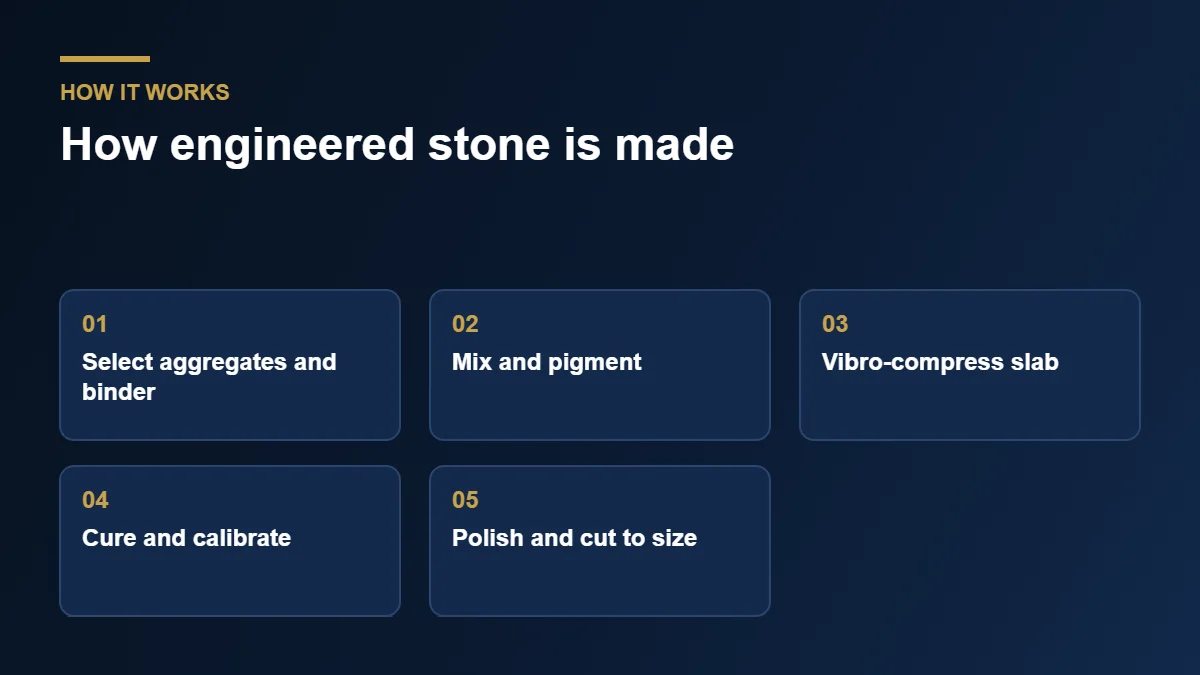
01
Drawings and selection
Dimensions, joints and edge profiles are agreed and the material family and colour are selected.
02
Slab or mould preparation
Quartz and sintered slabs are selected and marked for cutting. Cast stone moulds are prepared from the pattern.
03
Cutting or casting
Slabs are cut and shaped with controlled dust measures. Cast stone is mixed, poured and vibrated into moulds.
04
Curing or finishing
Cast stone is cured. Edges, polish and surface finishes are applied to slabs.
05
Assembly and jointing
Pieces are assembled, joints are bonded and colour-matched, and cut-outs are finished.
06
Inspection and packing
Dimensions, colour, flatness and edges are checked before packing for delivery.
DESIGN AND SAFETY
Design Details and Safe Fabrication
Large engineered stone slabs and sintered panels are heavy and need proper support, careful handling and correct lifting equipment. Countertops are supported by cabinets or frames designed for the load, and cut-outs are planned to avoid weakening the slab.
Cast stone elements are normally fixed to the structure with stainless steel anchors and sealed or pointed joints that allow for movement. Drainage details and drip grooves on sills and copings keep water from staining the facade.
Quartz-based engineered stone contains a high proportion of crystalline silica, so cutting and grinding must use wet methods, local exhaust ventilation and suitable respiratory protection. Some jurisdictions, including Australia from July 2024, have restricted engineered stone for this reason. Sintered stone and cast stone offer alternatives, and we are happy to discuss which family fits your project.
Specifier checklist
- Material family and colour samples
- Slab size, weight and support
- Edge profile, cut-outs and joints
- Fixing and movement for cast stone
- Drainage details on sills and copings
- Safe fabrication and installation practices
CAST POLYMER
Cast Polymer Quick Reference
Seamless resin-based surfaces for vanities, counters and walls.
GFRC
GFRC Panels and Architectural Elements
Lightweight cement-based cladding and cornices.
CAST MARBLE
Cast Marble (Cultured Marble)
Vanity tops, shower walls and sills in cultured marble.
Material Guide
How Engineered Surfaces Compare With Natural Stone
Quarried granite and marble are beautiful, but no two slabs are alike, and large pieces can hide fissures that only appear when the stone is cut. A manufactured alternative starts with selected aggregates, quartz or marble chips and a binder, then compacts and cures them into a uniform slab. The result is a material with predictable colour, consistent thickness and dependable strength that suits commercial schedules.
Density and low porosity are the headline benefits. Because the binder fills the voids between particles, the surface resists staining from tea, oil, wine and everyday cosmetics far better than many open-grained natural stones. This matters in kitchens, bathrooms, cafes and hospitals where hygiene and appearance must hold up under daily use without special sealing routines.
Colour and pattern are controlled in the factory. Designers can choose plain whites and greys, speckled terrazzo effects, soft veining or bold contemporary tones, and can order the same shade months later for an extension or repair. This repeatability is valuable for chains, housing developments and phased projects where consistency across many units is essential.
Size and thickness options influence cost and design. Large-format slabs reduce joints on islands and feature walls, while thinner sections suit cladding and vertical surfaces. Edge profiles such as straight, bevelled, bullnose or waterfall can be cut and polished, and cut-outs for sinks and hobs are templated before fabrication to prevent errors on site.
Heat and impact need sensible care. Resin-bound surfaces tolerate normal kitchen use but can be damaged by very hot pans, so trivets are recommended. Heavy impact on corners can chip any stone product. Good detailing, rounded edges and correct support along the substrate reduce these risks and keep the installation looking new for longer.
Applications
Designing With Slabs in Homes and Commercial Spaces
Kitchens are the largest market. A continuous worktop with an integrated upstand, a waterfall edge on an island and a matching splashback gives a calm, high-end appearance. Accurate templating, careful seam placement and proper support under overhangs ensure the surface stays flat, strong and visually seamless, even on busy family kitchens.
Bathrooms and wet areas use vanity tops, shower walls, window sills and bath surrounds. Low porosity helps prevent mould and mildew, and light, even colour makes small spaces feel open. Choose a finish with enough texture to hide water spots, and specify suitable adhesives and silicone for damp environments to avoid moisture issues behind the slab.
Commercial interiors rely on durable surfaces. Reception desks, bar tops, retail counters, hotel lobbies and restaurant tables must survive heavy traffic and frequent cleaning. Slabs can be fabricated into curved or faceted forms, edged with metal trims and lit from behind in translucent versions to create a memorable brand moment.
Vertical cladding and flooring are growing categories. Thin slabs on lobby walls, lift cores and feature columns deliver the look of stone with much lower weight than natural slabs. Plan joint locations early, fix with a suitable adhesive and mechanical support, and confirm the slip rating of any floor finish before it is approved for public areas.
Pairing materials gives the best results. Surfaces in engineered stone often sit alongside cast marble details or architectural metal trims, so colour matching and tolerance planning should be done together. Our full product range is designed to work as a coordinated palette.
Fabrication and Care
Templating, Installation and Everyday Maintenance
Fabrication begins with accurate measurement. A technician visits the site, records wall positions, appliance cut-outs and sink details, and produces a template or digital drawing. The slab is then cut by CNC or bridge saw, edges are profiled and polished, and the finished pieces are checked against the drawing before they leave the factory.
Installation requires a level, sound base. Cabinets must be fixed and levelled, supports positioned at the correct spacing and adhesive applied according to the manufacturer’s instructions. Joints are colour-matched and kept tight, and sealant is used at junctions with walls, sinks and splashbacks. Our installation service coordinates these steps with the main contractor.
Daily care is simple. Clean with warm water and a mild cleaner, avoid harsh solvents and abrasive pads, and wipe spills promptly. Use chopping boards and trivets to protect the surface. With this basic routine, a well-made slab keeps its gloss and colour for many years, and the cost of ownership remains low compared with surfaces that need regular sealing.
Specification details should be recorded. Note slab thickness, edge type, finish, joint positions, cut-out sizes and the warranty terms. A short data sheet signed by all parties prevents misunderstandings. Our manufacturing team supplies this documentation and can provide samples so clients approve colour and texture in their own lighting.
For general background on the natural stone these products imitate, see the engineered stone article on Wikipedia. To start a project, contact HB Design Driven with your plans, preferred colours and timeline and we will return a clear proposal.
Project Checklist
Before You Order Engineered Stone
Before ordering engineered stone, confirm the colour in daylight, check slab availability and agree the edge profile, thickness and seam positions. Make sure cabinets are installed and level, because engineered stone should not be cut or adjusted on site once it has been delivered. A written template approval prevents costly errors.
Ask about lead times and what happens if a slab is damaged in transit. Reliable suppliers keep spare material from the same batch so repairs match perfectly. If your project involves several units, order all engineered stone together to maintain consistent shade and pattern across the whole development, and keep a record of the batch number for future reference.
FAQ
Engineered Stone: Frequently Asked Questions
GET STARTED
Request an Engineered Stone Quote
Send your drawings, dimensions and finish preferences and we will come back with options. Call +92 300 6685798 or email hbdesigndriven@gmail.com.