CAST POLYMER · QUICK REFERENCE GUIDE
Cast Polymer: Cultured Marble, Granite, Onyx and Solid Surface Explained
A plain-language guide to resin-based cast surfaces: what they are made of, how they differ and which one suits your counters, vanities and wet areas.
Cast polymer at a glance
- Resin plus mineral filler, cast in moulds
- Includes cultured marble, granite, onyx and solid surface
- Non-porous, seamless and easy to clean
- Interior use for counters, vanities and walls
- Made to your dimensions
WHAT IS CAST POLYMER?
What Is Cast Polymer?
Cast polymer is the umbrella term for surfaces made by mixing resin with mineral filler and pigments and casting the mixture in a mould. When it hardens, the result is a solid, non-porous material that can be formed into vanity tops, countertops, shower walls, sills and panels without the joints of tiled or slab surfaces.
The family includes cultured marble, cultured granite and cultured onyx, which are usually finished with a gelcoat, and solid surface, which is a through-body material generally supplied as sheet and fabricated into shape. They look similar at first glance but behave differently in repairability, jointing, translucency and cost.
Choosing between them depends on how the surface will be used. Gelcoated cultured products are an economical way to get seamless one-piece vanities and wet-wall panels. Solid surface suits counters and reception desks where seamless joints, thermoforming and refinishing matter more.
HB Design Driven can advise on the right type for your project and make the surface to your drawings. See also our pages on cast marble and engineered stone.
Key facts
- Resin and mineral filler cast in moulds
- Gelcoated types: cultured marble, granite, onyx
- Through-body type: solid surface
- Non-porous and easy to maintain
- Interior wet and dry areas
- Seamless forms and integrated basins
APPLICATIONS
Where Cast Polymer Is Used
Cast polymer is a practical choice wherever hygiene, seamless joints and easy cleaning matter.
BATHROOMS
Vanity tops and basins
One-piece tops with integrated basins in many colours and edge profiles.
SHOWERS
Shower walls, bases and tub surrounds
Large panels that reduce grout lines and speed up installation.
KITCHENS
Countertops and splashbacks
Seamless counters and coved backsplashes that are simple to wipe clean.
RECEPTION
Desks and counters
Solid surface can be joined seamlessly and shaped into curves.
SILLS
Window sills and thresholds
Custom lengths cast with matching colour and edges.
COMMERCIAL
Hospitality and healthcare
Hygienic surfaces for hotels, clinics and apartment blocks.
BENEFITS AND TRADE-OFFS
Benefits and Trade-Offs of Cast Polymer
Cast polymer is versatile, but each type has its own strengths.
Advantages
- Non-porous, stain-resistant and hygienic
- Seamless forms with integrated basins
- Wide colour and pattern choice
- Custom sizes and edge profiles
- Solid surface can be refinished and joined invisibly
- Cost-effective for repeated bathroom components
Points to consider
- Interior use only
- Heat and harsh chemicals can damage the surface
- Gelcoated types can show surface wear over time
- Solid surface usually costs more than cultured marble
- Less hard than quartz for heavy chopping and impacts
- Colours and patterns should be approved on samples
TECHNICAL DATA
Cast Polymer Types Compared
A quick reference to the main members of the cast polymer family.
| Type | Composition | Surface and joints | Repairability | Typical use |
|---|---|---|---|---|
| Cultured marble | Polyester resin, marble or mineral filler, gelcoat | Glossy gelcoat; seams may be visible | Surface can often be polished; gelcoat damage is harder to fix | Vanity tops, shower walls, sills |
| Cultured granite | Similar to cultured marble with granite-effect flecks | Glossy gelcoat | As cultured marble | Vanities and counters with a granite look |
| Cultured onyx | Similar to cultured marble with veined, translucent effect | Glossy gelcoat | As cultured marble | Feature panels and vanities |
| Solid surface | Acrylic, polyester or similar resin with mineral filler, no gelcoat | Matte to satin; seamless joints | Can be sanded and refinished | Counters, reception desks, wall linings |
General comparison only. Products and formulations vary between suppliers, so confirm data sheets before specifying.
HOW IT IS MADE
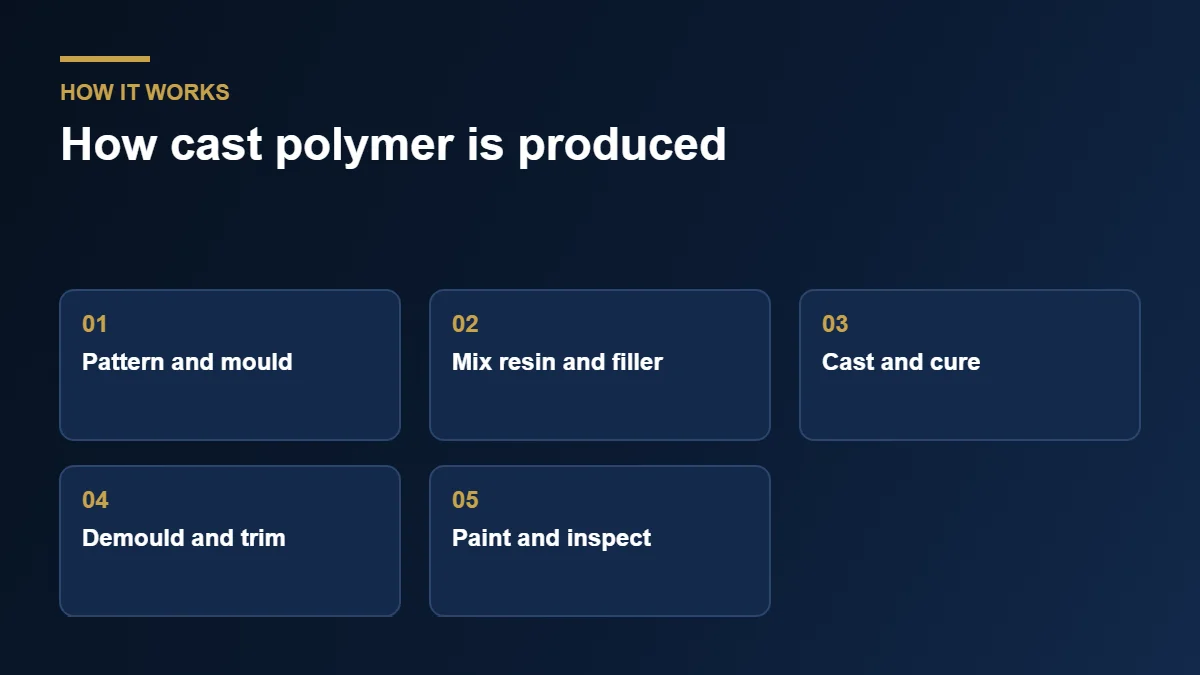
How Cast Polymer Surfaces Are Made
The process is similar across the family, with gelcoat and through-body routes.
01
Drawings and mould selection
Sizes, cut-outs and edges are agreed and the mould is prepared.
02
Gelcoat (cultured types)
A pigmented gelcoat is sprayed into the mould to form the glossy outer face.
03
Mixing and casting
Resin, filler and pigment are mixed and poured into the mould, then left to harden.
04
Demoulding or sheet fabrication
Cultured pieces are demoulded. Solid surface sheet is cut, joined and thermoformed as required.
05
Trimming and polishing
Edges are trimmed, ground and polished and openings are cut to size.
06
Inspection and packing
Colour, flatness and finish are checked before packing for delivery.
CHOOSING THE RIGHT TYPE
How to Choose Between Cast Polymer Types
If the priority is a one-piece vanity top with an integrated basin and a glossy finish at a sensible cost, cultured marble is usually the right choice. If you want granite-like flecks or onyx-style veining, cultured granite or onyx offers those looks in the same process.
If the project needs seamless joints between several pieces, curved or thermoformed shapes, or a surface that can be sanded back after years of use, solid surface is the stronger option, particularly for commercial counters and reception desks.
For kitchen worktops that face heavy use, hot pans and knives, consider engineered stone instead, and talk to us about the right surface for each room.
Quick decision guide
- Seamless one-piece vanity: cultured marble
- Granite or onyx look: cultured granite or onyx
- Invisible joints or refinishing: solid surface
- Heavy kitchen use: engineered stone
- Facade or exterior: not suitable, see GFRC or metal
CAST MARBLE
Cast Marble (Cultured Marble)
Vanity tops, shower walls and sills in cultured marble.
ENGINEERED STONE
Engineered and Artificial Stone
Quartz, sintered stone and cast stone for demanding surfaces.
Material Guide
What Makes Resin-Based Casting Practical
Resin-based casting combines a liquid polymer with mineral fillers and, where needed, fibre reinforcement. The mixture flows into a detailed mould, cures in a controlled environment and emerges as a rigid, stable piece. Because the liquid captures fine undercuts and sharp arrises, even elaborate classical ornament reproduces cleanly, and every repeat looks identical to the first, which is difficult to achieve with carving or hand plastering.
Weight is a major advantage. A decorative cornice or capital cast in resin may weigh a small fraction of the same piece in plaster or stone. Light elements are easier to lift, quicker to fix and gentler on old structures, which makes them popular for refurbishment and for upper-floor decoration where heavy materials would require extra support or specialist cranes.
Moisture resistance is equally important. Unlike gypsum, a properly formulated resin casting does not swell, crumble or lose shape when it meets humidity or rain, so it works on exterior mouldings, bathrooms, pool areas and covered terraces. The material is also dimensionally stable, which reduces cracking at joints and keeps long runs of moulding straight over time.
Finish options are broad. Factory primer allows painting on site, while factory-applied stone, plaster, bronze or gold effects deliver a more convincing appearance with less site labour. Specify colour references, sheen level and the touch-up system, and request a sample from the actual production mould, not just a photograph, so you can judge detail depth and surface quality.
Compared with heavier masonry, resin systems are fast to produce and easy to modify. If the design changes, a new mould insert or a revised profile can be made quickly. That flexibility helps architects respond to client feedback during construction and lets contractors keep their programme on track, even when the decorative scope grows late in the job.
Design Ideas
Applying Decorative Castings Across a Building
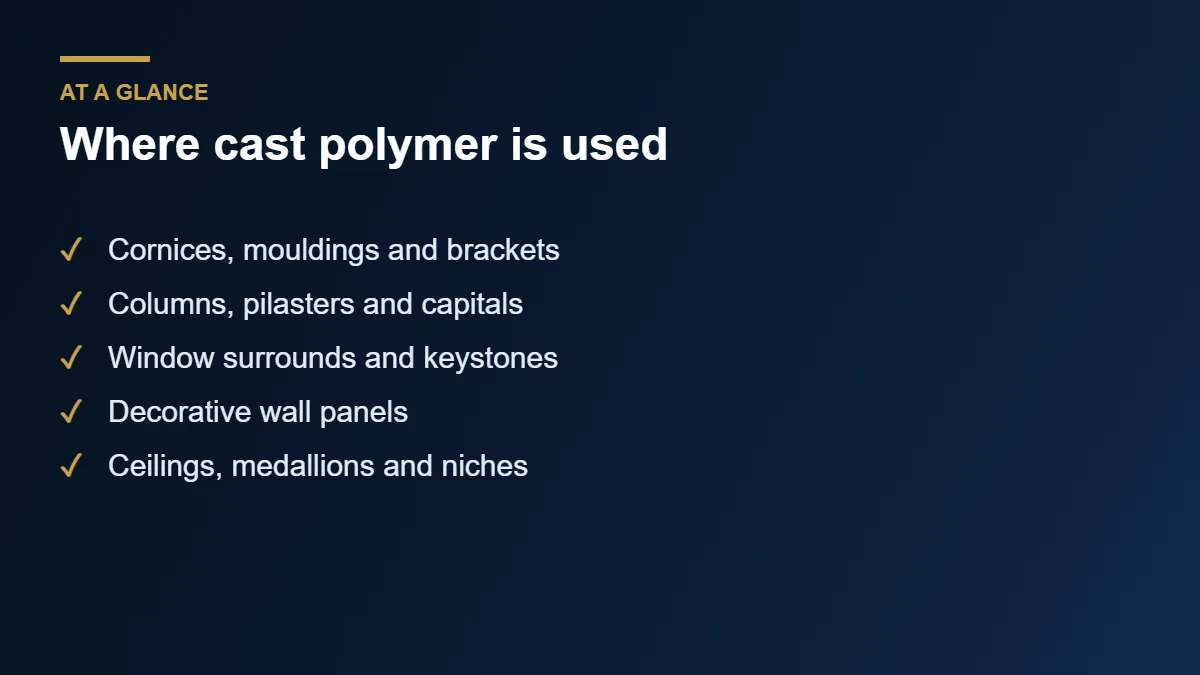
Cornices and crown mouldings are the classic application. Running along the top of a facade or interior wall, they define the silhouette and give the building a finished appearance. Profiles can be simple and contemporary or deeply layered in a traditional style, and long lengths are joined with hidden connectors so seams stay barely visible after painting.
Columns and pilasters create presence at entrances, porches and double-height lobbies. Bases, shafts and capitals are cast separately and assembled on a concealed core, which makes tall features practical and transport-friendly. Fluting, banding and proportion should follow the chosen architectural language so that the order feels coherent rather than decorative for its own sake.
Window surrounds, keystones, brackets and quoins add rhythm to elevations. Repetition is a strength here, because identical units help the facade read as one composition. Fix them carefully to the substrate, align them with a string line and seal edges to prevent water tracking behind, especially at horizontal ledges where rain can collect.
Interior ceilings and walls benefit from medallions, coffers, niches and panelling. Resin pieces can imitate carved timber or plaster while remaining lighter and more durable. Pair them with discreet lighting to bring out relief detail, and use a consistent paint scheme to unify old and new elements in renovation projects.
Combining systems is common. A facade may use cast marble at the entrance, GFRC panels for large surfaces and cast polymer for light-weight decoration at upper levels. Our design team can coordinate colour, joint pattern and fixing so these materials read as one considered envelope, and our products overview explains each option.
Installation and Care
Fixing, Finishing and Maintenance
Correct fixing starts with a sound substrate. Surfaces should be clean, dry and flat, and anchors must match the wall type, whether concrete, brick or steel frame. Adhesives are chosen for compatibility with the resin, and mechanical fixings support heavier components. Pieces are dry-fitted first, then bonded, aligned and held until the adhesive sets.
Joints and finishing determine the final look. Gaps are filled with a flexible filler, sanded smooth and painted to match, so long runs appear continuous. External joints use weatherproof sealants that allow slight movement. Our installation crews follow a written method and check alignment at every stage before painting begins.
Maintenance is minimal. Dust the surface regularly, wash exterior pieces with mild detergent once or twice a year, and repaint when the coating shows wear, typically after several years depending on exposure. Minor damage can be repaired by filling and repainting, which is far easier than replacing a carved stone unit or rebuilding a plaster detail.
Quality assurance should be part of every order. Ask for dimensional checks, a surface inspection, a written warranty and clear labelling for each piece. In our manufacturing process, every casting is reviewed before packing, and protective wrapping prevents scratches during delivery to sites across Pakistan.
For general background on polymer materials, see the polymer entry on Wikipedia. When you have drawings or reference photos, talk to HB Design Driven and we will recommend profiles, finishes and a realistic delivery schedule.
FAQ
Cast Polymer: Frequently Asked Questions
GET STARTED
Request a Cast Polymer Quote
Tell us where the surface will be used and we will recommend the right type. Call +92 300 6685798 or email hbdesigndriven@gmail.com.