ARCHITECTURAL PRODUCTS
Architectural Products for Facades, Interiors and Custom Elements
Six material systems, one design-led manufacturer. Explore GFRC, GFRP, architectural metal, cast marble, cast polymer and engineered stone, each made to your drawings in Pakistan.
Two product families
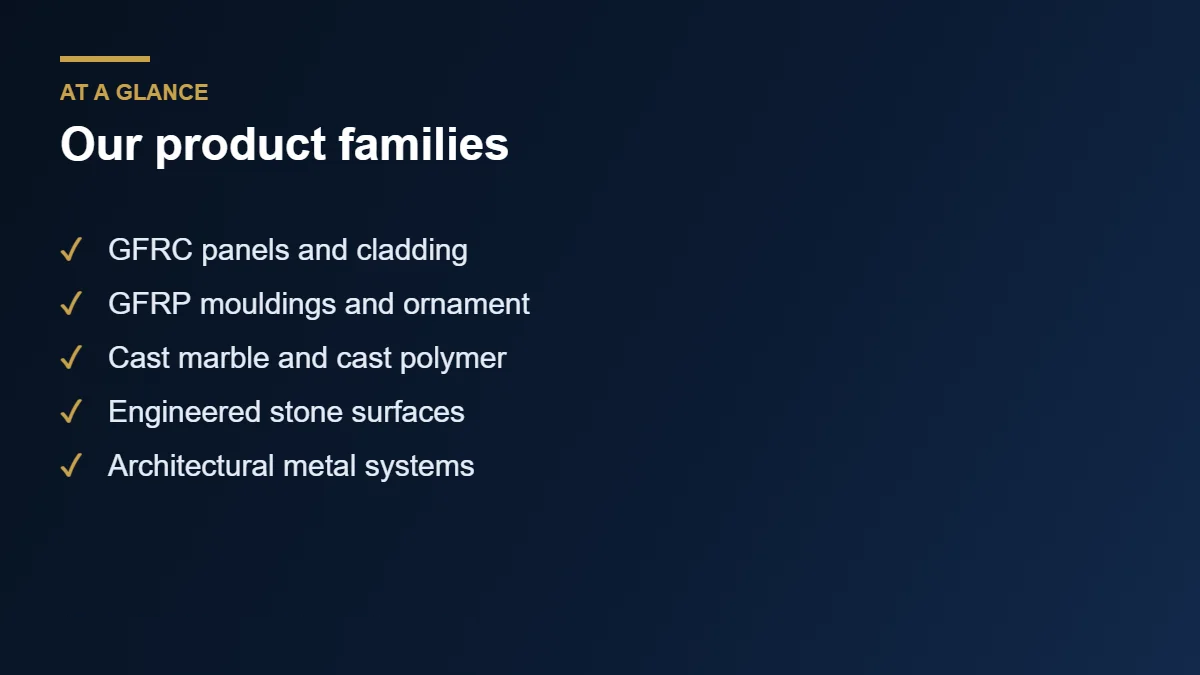
- Exterior and facade: GFRC, GFRP, architectural metal
- Interior surfaces: cast marble, cast polymer, engineered stone
- Custom shapes, colours and finishes
- Supply-only or supply-and-install
PRODUCT RANGE
A Complete Range of Architectural Products
Architectural products are the elements people see and touch: the cladding on a facade, the cornice above a window, the screen that filters sunlight, the vanity top in a hotel bathroom. They are chosen for how they look, but they also have to carry loads, resist weather, behave sensibly in a fire and stay serviceable for decades.
HB Design Driven manufactures six material systems so that the product can be matched to the job rather than the other way round. Exterior systems such as GFRC, GFRP and architectural metal are designed for facades, cornices, columns and screens. Interior systems such as cast marble, cast polymer and engineered stone provide seamless, easy-to-clean surfaces for bathrooms, kitchens and reception areas.
Every product page below explains typical applications, composition, performance points, finishes and how to specify it. If you are still deciding, the comparison table and selection guide further down will help narrow the choice.
EXTERIOR AND FACADE
Facade and Exterior Architectural Products
Weather-exposed elements need materials that handle sun, rain, wind and thermal movement for decades.
GFRC
GFRC Panels and Architectural Elements
Thin, strong cement-based panels for rainscreen cladding, column covers, cornices, parapets and decorative facade features. Generally non-combustible when tested.
GFRP / GRP
GFRP Cladding, Cornices and Columns
Very light, resin-based shells for cornices, columns, domes, arches and curved details where weight is the main constraint.
METAL
Architectural Metal Products
Aluminium, stainless and coated steel facade panels, perforated screens, railings, soffits and column covers with durable finishes.
INTERIOR SURFACES
Interior Surfaces and Fixtures
Seamless, hygienic and low-maintenance surfaces for wet areas, counters and feature walls.
CAST MARBLE
Cast Marble (Cultured Marble)
Mould-formed vanity tops with integrated basins, shower walls, window sills and wall panels without grout lines.
CAST POLYMER
Cast Polymer Quick Reference
How cultured marble, cultured granite, cultured onyx and solid surface differ, and which suits counters and wet areas.
ENGINEERED STONE
Engineered and Artificial Stone
Engineered quartz, sintered stone and cast stone for countertops, wall panels, copings, sills and architectural details.
COMPARE MATERIALS
Material Comparison: Which Product Fits Your Project?
A quick starting point. Always confirm fire, load and durability requirements against your specification.
| Material | Composition | Typical products | Weight | Fire behaviour |
|---|---|---|---|---|
| GFRC | Cement, sand, polymer and alkali-resistant glass fibre | Cladding, cornices, column covers | Light | Generally non-combustible when tested |
| GFRP / GRP | Glass fibre in polyester or similar resin | Cornices, columns, domes, curved shells | Very light | Combustible; depends on assembly testing |
| Architectural metal | Aluminium, stainless or coated steel | Facade panels, screens, railings | Light to medium | Non-combustible (solid metal) |
| Cast marble | Marble dust, resin and gelcoat | Vanity tops, shower walls, sills | Medium | Interior use; not a facade material |
| Cast polymer | Resin and mineral filler (varies) | Counters, wall linings, wet areas | Medium | Interior use; varies by resin |
| Engineered stone | Quartz or mineral aggregate with resin; sintered or cast stone | Countertops, panels, cast stone details | Medium to heavy | Mineral-based; check each data sheet |
Properties vary by product and supplier. Request data sheets for the exact system you plan to specify.
SELECTION GUIDE
How to Choose Between These Materials
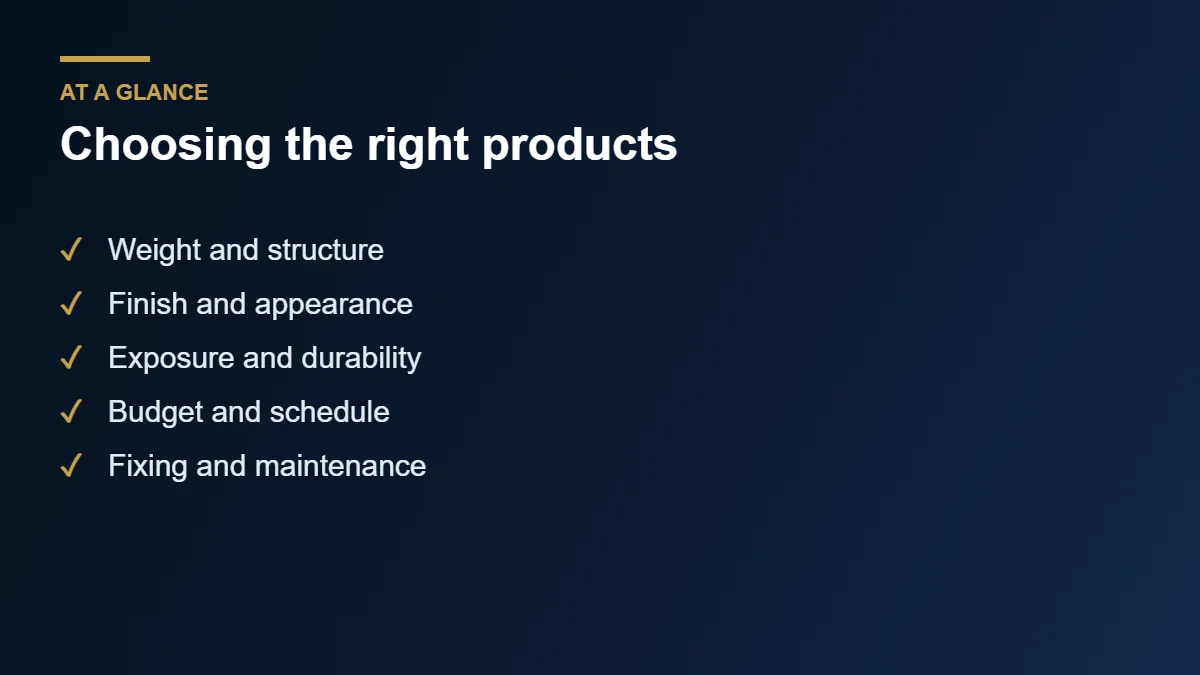
Four questions narrow the choice quickly.
01
Where will it be used?
Exterior elements need weather and UV resistance. Interior wet areas need non-porous, hygienic surfaces. Start with exposure.
02
What load and weight can the structure carry?
Lightweight GFRC and GFRP reduce load on sub-frames and speed up lifting. Heavier stone suits floors, counters and ground-level details.
03
What fire and compliance rules apply?
Non-combustible materials such as GFRC and solid metal suit many facade requirements. Resin-based systems depend on assembly-level testing.
04
What maintenance and budget are acceptable?
Consider coating upkeep, cleaning routines, repairability and total installed cost, not just the material price.
CUSTOM WORK
Custom Shapes, Colours and Finishes
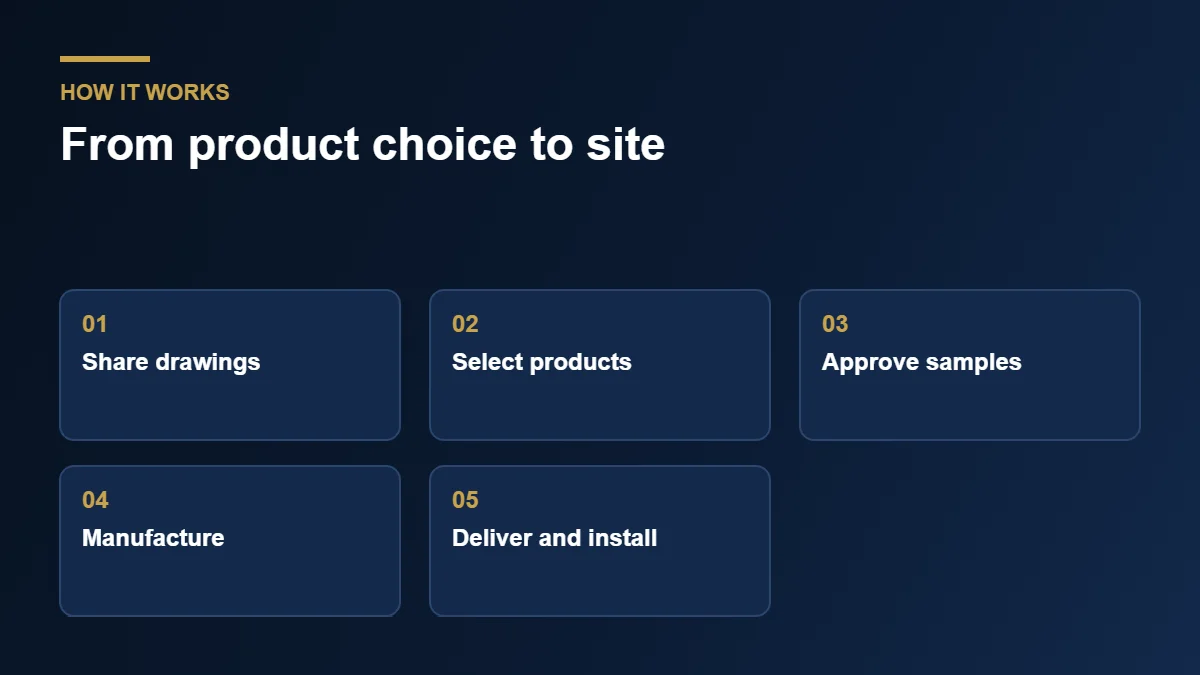
Most architectural elements are made to order. We develop custom profiles, curves and repeating panel patterns from architects’ drawings into production moulds or fabrication details, so one approved design can be repeated consistently across a whole building.
Cast and fabricated products can be finished in smooth, textured or stone-like surfaces, and colours are agreed on samples before production so batches match across the project.
Customisation options
- Custom profiles, cornices and mouldings
- Smooth, textured and stone-effect finishes
- Colour matching from approved samples
- Perforation and pattern designs for metal screens
- Integrated basins and edge profiles for cast surfaces
STANDARDS AND QUALITY
Standards, Testing and Specification Support
Specifiers usually ask for evidence that a system will perform in service. Depending on the material, projects commonly reference PCI MNL-128 and GRCA guidance for GFRC, ASTM C1364 for cast stone, and test methods such as ASTM E330, E283 and E331 for facade assemblies, and ASTM E84 or EN 13501-1 for reaction to fire.
We supply data sheets, finish samples, shop drawings and installation details to support the project engineer’s review. If your specification requires particular test reports, tell us at the start so we can confirm what is available.
Exterior Guide
Selecting Products for Facades and Landscape
Exterior products work harder than any other part of a building. They face sun, rain, dust, temperature swings and sometimes impact, while also defining the first impression of the property. For that reason, selection should balance appearance with weight, durability and ease of maintenance, and every choice should be tested against the climate where the building stands.
Lightweight cladding is the usual choice for large elevations. Thin glass fibre reinforced systems create sculptural profiles without overloading the structure, and they install quickly with adjustable fixings. Where a heavier, more mineral character is wanted, solid cast elements can be used at the base, entrance and cornice, with lighter products covering the upper floors.
Decorative features such as columns, balustrades, urns, fountains and entrance arches suit cast materials, because moulds capture fine detail and repeat it consistently. For modern designs, metal fins, screens, canopies and perforated panels provide clean lines and let light and air through. Mixing product types is common, provided colours and joints are coordinated early.
Landscape elements need extra thought. Garden products stand in contact with soil, irrigation and weather, so sealed surfaces, drainage holes and stable bases are essential. Choose finishes that hide dust and water marks, and avoid very dark glossy surfaces in areas where dirt shows easily.
Whatever you select, ask for samples, finished photographs and written specifications. Visit our GFRC, GFRP and metal pages for technical detail and typical applications.
Interior Guide
Selecting Products for Interiors and Surfaces
Interior products should combine beauty with practicality. Cornices, wall panels, niches, fireplaces and ceiling features add character, while surfaces such as vanities, counters and reception desks must withstand daily use. Think about cleaning, moisture, lighting and traffic before choosing a finish, because these factors affect how well the product will look over time.
Decorative mouldings in resin or stone-effect materials are light and easy to fix, which helps in refurbishment and in upper-floor spaces. Engineered stone slabs suit worktops and vanities, and their low porosity resists staining. Marble-effect cast pieces give warmth and grandeur to entrances, staircases and lounges without the weight and variation of natural slabs.
Colour and texture should be reviewed together. A small sample can look different on a large wall, so view products in the actual lighting of the room, at different times of day. Bring paint, fabric and flooring samples to the same table, and ask us to match tones where needed. A well-chosen palette makes the space feel calm and complete.
Fixing details need advance coordination. Wall build-ups, services and ceiling heights determine how products are supported, and recesses for lighting or ventilation must be planned before production. Our team reviews interior drawings and suggests practical solutions that keep the design intent intact.
For worktops and surfaces, see the engineered stone page, and for classical detail, explore cast marble and cast polymer.
Quality Assurance
How We Ensure Product Quality
Quality begins with materials. Cement, aggregates, resins, fibres, pigments and metals are sourced from reliable suppliers and checked on arrival. Mixes follow documented recipes, and batches are recorded so each product can be traced. Consistent inputs lead to consistent outputs, which matters when hundreds of elements must match.
Moulds are inspected before every use, and finished products are measured against the drawing. Surface finish, colour and fixing inserts are checked under strong light, and approved reference samples remain in the workshop for comparison. Any defective unit is corrected or remade before it is packed.
Packing protects the work. Products are wrapped, padded and secured on frames or crates, labelled with their location and loaded in installation order. This care in the final stage prevents scratches and chips, saving time and cost on site and keeping the finish as intended.
Documentation completes the package. Clients receive data sheets, drawings, colour references and care instructions, so everyone understands what has been supplied and how to maintain it. Our manufacturing process explains each stage in more detail.
For independent background, the cladding article on Wikipedia describes how building skins are designed and fixed. When you are ready to proceed, contact HB Design Driven for advice on the best products for your project.
Support
Delivery, Installation and Aftercare for Our Products
Delivery is planned around your construction programme. We coordinate dispatch dates, vehicle sizes, storage requirements and unloading methods with the site team so products arrive when they are needed, not weeks too early or too late. Clear labelling helps installers find each unit quickly and keeps the sequence organised.
Our installation team can fix products on your behalf, or we can supply drawings and guidance to your own contractor. In both cases, accuracy is the priority: correct set-out, adjustable fixings, tidy joints and careful handling of finished surfaces. We also review snagging lists promptly to help you reach completion without delay.
Aftercare keeps products looking good. Simple washing, periodic inspection and timely touch-ups preserve colour and protect joints. We keep records and moulds so replacements can be produced if needed, and we provide advice whenever a question arises. Browse our completed projects to see how products perform in real buildings.
FAQ
Architectural Products: Frequently Asked Questions
GET STARTED
Request Samples, Drawings Review or a Quote
Tell us what you are building and which materials you are considering. Call +92 300 6685798 or email hbdesigndriven@gmail.com.